

Your manuals are printed, the policies are signed and the audit date is fixed. So why does your quality manager still look nervous? Because documents are only half of what an auditor checks. The other half is how your people really work.
This ISO audit checklist is built for that second half. An ISO certification audit tests whether your management system meets the standard you chose and whether you actually run it day to day. By the end of this guide you will know:
The checklist suits factories, food businesses, IT companies and service firms across Bangladesh, whichever management system standard you are working toward. No checklist can promise a pass. It can take most of the avoidable surprises off the table, and that is where good ISO audit preparation pays off.
An ISO certification audit is an independent check of your management system. The auditor reads your documented information, watches your processes, talks to your staff and asks for records. Then they compare all of it against the standard.
Your own team, or someone you appoint, audits your system before anyone outside does. The aim is to find nonconformities and improvement opportunities while they are still your private business. Treat it as a proper rehearsal, not a formality.
An independent certification body audits you to decide whether you meet the certification requirements. This is the external ISO audit. The certificate carries that body’s name, so check that it is accredited before you sign with it.
Stage 1 looks at readiness: your scope, your documented information and whether the system is set up well enough to be assessed in full. Stage 2 is where the auditor checks that the system is truly implemented and working. The details differ by standard and certification scheme, so ask your certification body to explain the ISO certification audit process early.
Check your edition first. ISO 9001:2026 was published on 16 September 2026 and ISO 14001:2026 in April 2026, each with a transition period of about three years for already-certified organizations. ISO 45001:2018, ISO 22000:2018 and ISO/IEC 27001:2022 are the current editions of those standards, each with a 2024 climate change amendment. Ask your certification body which edition it will audit you against.
Work through these ten areas in order. Each covers what to check, why it matters, what evidence to have ready and a Bangladesh-style example. The examples are illustrative scenarios, not stories from HMS clients.
Check that your written scope names the activities, products and services, departments, processes and sites your management system covers. If the standard lets you treat a requirement as not applicable, write down why. Some standards allow limited exclusions and others allow none.
Why it matters: the scope is printed on your certificate, and the auditor audits what it says. Any gap between scope and reality becomes a problem on audit day.
Have ready: the scope statement, a site list, a process map and the reasoning behind any exclusion.
Example: a garment factory in Gazipur lists cutting, sewing and finishing in its scope. Its washing is done in a unit across the road, and nobody wrote that down. The auditor will ask. Decide whether the washing unit is in or out, then record the reason.
Standards use “documented information” for two things. One tells people what to do: policies, procedures, work instructions and process documents. The other proves it was done: registers and records. A cleaning procedure explains how to clean a filling machine. A cleaning log shows someone did it on Tuesday.
Check that documents are approved, carry a revision number and are the current versions where people work. Your ISO documentation requirements depend on the standard and your processes, so build your list from the standard, not from a downloaded template. And remember that owning documents is not enough. Staff must follow them.
Have ready: a master document register, approval records, revision history and completed records.
Example: a packaging workshop in Narayanganj updated its cleaning procedure to Revision 3 in the office, but Revision 1 is still taped beside the machine. That is a finding waiting to happen.
Check that you know which legal and regulatory requirements apply to you, who watches for changes and how often you evaluate compliance. Depending on your business, they may cover environmental rules, workplace health and safety, food safety, industry regulations, and the licences and approvals you must hold. Take your list from the relevant authorities or a qualified advisor, not from a generic list online.
These ISO audit requirements are easy to miss because nobody owns them until an auditor asks.
Have ready: a register of applicable requirements, compliance evaluation records, licence copies with valid dates and any inspection reports from authorities.
Example: a manufacturer keeps its operating licences in a drawer, and the renewal dates live in one person’s memory. If that person is on Eid leave, nobody notices a licence close to expiry. A register with dates and a named owner fixes it.
Auditors talk to people on the floor, not only to managers. They may check whether staff understand your policy, know their responsibilities, follow the procedures for their own job and know how to report a problem.
Example: an auditor asks a production worker, “What do you do when a product fails inspection?” A good answer is plain and true: “I put it in the red tray, tell my supervisor and it gets recorded.” A scripted answer sounds scripted, and one follow-up question usually shows it.
So do not hand people lines to memorize. Help them understand their real responsibilities, and if your team talks about the work in Bangla, explain procedures in Bangla too. Good ISO audit preparation includes short toolbox talks well before the audit.
Have ready: training records, a competence matrix or job requirements, induction records and toolbox talk attendance sheets.
Check that what people do matches what your procedures say. Take the procedure in your hand and walk the process. Pick the examples that fit your standard and scope:
Your ISO certification audit checklist should work as a walking list, not a desk exercise. If worker safety is in your scope, look for hazards on the same walk. Our page on ISO 45001 certification in Bangladesh explains how occupational health and safety fits into a management system.
Have ready: inspection records, cleaning logs, temperature charts, maintenance logs, access rights lists and backup test records.
Example: a food processor’s procedure says chiller temperature is checked every two hours. The log shows two checks a day. Either the procedure or the practice has to change before the auditor notices.
Check how you identify, evaluate and deal with risks and opportunities. Typical examples are production interruptions, supplier problems, workplace hazards, environmental impacts, information security threats and food contamination. A useful ISO audit checklist asks one plain question here: what could go wrong, and what did we do about it?
The method changes with the standard:
Have ready: a risk register or assessment records, action plans and proof that you review them.
Example: a Chattogram importer buys a key input from one supplier, and a late shipment stops the line for a week. The auditor will want to see that you already rated that risk and chose an action, such as approving a second supplier.
Look at every earlier finding, whether it came from a complaint, an internal audit or a certification body. For each one, your records should show:
Why it matters: an ISO audit nonconformity that returns after you supposedly fixed it tells the auditor your system does not learn.
Have ready: nonconformity reports, root cause records, action plans with owners and dates, proof of completion and effectiveness checks.
Example: a factory keeps finding loose buttons at final inspection. Retraining the operators does not stop it. A root cause review shows the only button-strength check happens after packing, when nobody wants to open cartons. The corrective action moves the check to the end of the sewing line, and the team tracks the defect rate for a month to confirm it held.
Complete a full internal audit before the external one. Check that you have an audit programme, clear criteria and scope, and auditors who are competent and impartial. Impartial means people do not audit their own work: your accounts manager can audit purchasing, but not accounts. Then check for written findings, a report and follow-up on every corrective action.
Build your ISO internal audit checklist from the standard’s requirements and your own procedures, then add the questions that matter on your site. If you work with ISO 9001, our guide to ISO 9001 requirements shows what those questions should cover. The audit should test whether the system works in practice. Confirming that a document exists is not enough.
Have ready: the audit programme, completed checklists, reports, auditor competence records and follow-up records.
Example: in a mid-size plant, the QA supervisor owns the quality procedures and also audits the QA department. Findings are suspiciously rare. Swapping auditors between departments gives you an honest result.
Management review is where top management looks at how the system is performing and decides what to do about it. Typical inputs are the status of earlier actions, changes affecting the system, performance and objective results, audit findings, customer or stakeholder feedback, risks and opportunities, and improvement opportunities. The outputs are decisions and actions. Exact inputs and outputs depend on your standard, so check it before planning the agenda.
Have ready: the agenda, attendance list, signed minutes and an action tracker.
Example: the managing director signs minutes the ISO coordinator prepared the day before, and half the content is last year’s with the date changed. Expect the auditor to put a few direct questions to top management. The person who signs the minutes should have been in the room.
Objective evidence is information an auditor can verify. Typical examples are training records, inspection reports, equipment maintenance records, calibration records where applicable, supplier evaluations, complaint records, internal audit reports, management review minutes and corrective action records.
Good ISO audit evidence is authentic, relevant, traceable and consistent with what really happens in the business. Never create or backdate records to fill a gap. A visible gap you are already fixing is far easier to defend than a record that falls apart under one question. Your ISO audit documents only count when real activity stands behind them.
Example: a manufacturer’s calibration register says the weighing scale was calibrated in March. The sticker on the scale says March and the certificate in the file matches. Everything lines up, so the auditor moves on.
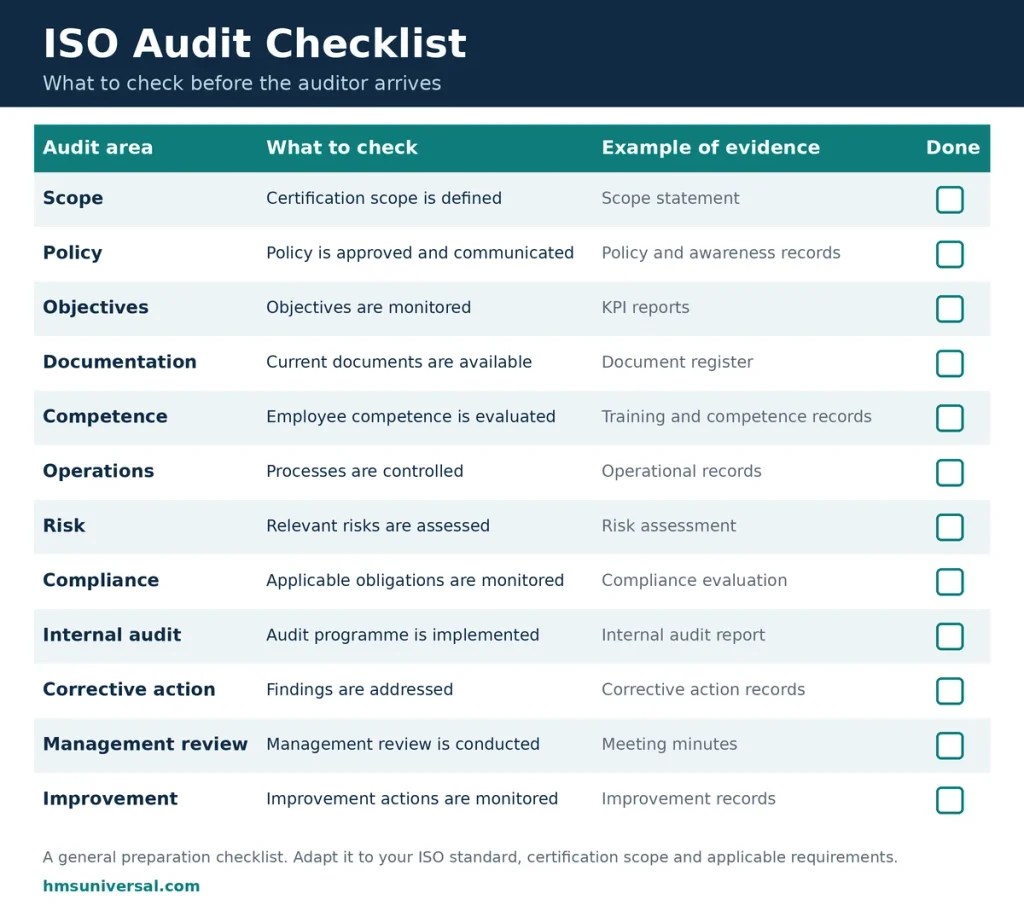
Print this table and use it for a quick walk-through a few weeks before the audit. The last column is for your own notes.
| Audit area | What to check | Example of evidence | Status |
|---|---|---|---|
| Scope | Certification scope is defined | Scope statement | |
| Policy | Policy is approved and communicated | Policy and awareness records | |
| Objectives | Objectives are monitored | KPI reports | |
| Documentation | Current documents are available | Document register | |
| Competence | Employee competence is evaluated | Training and competence records | |
| Operations | Processes are controlled | Operational records | |
| Risk | Relevant risks are assessed | Risk assessment | |
| Compliance | Applicable obligations are monitored | Compliance evaluation | |
| Internal audit | Audit programme is implemented | Internal audit report | |
| Corrective action | Findings are addressed | Corrective action records | |
| Management review | Management review is conducted | Meeting minutes | |
| Improvement | Improvement actions are monitored | Improvement records |
This is a general preparation checklist. Adapt it to your selected ISO standard, your certification scope and the requirements that apply to you.
These are the habits that turn a decent ISO audit preparation effort into audit findings:
Use your ISO certification audit checklist as a recurring habit, not a once-a-year scramble.
A nonconformity means a requirement was not fulfilled. The requirement may come from the standard, from your own procedures or from a legal obligation you have committed to meet. Many certification bodies grade findings by seriousness, often as major or minor. An observation or opportunity for improvement is different. It is not a failed requirement, just a point the auditor thinks could become one or could be done better. Whether your scheme uses these labels varies, so ask your certification body.
The auditor writes each finding into the audit report, along with the requirement and the evidence behind it. Then the work moves to you. Investigate the cause, correct the problem and put a corrective action in place. Send evidence to the certification body within the time it gives you. It will evaluate that evidence and may check it at a later visit.
A single minor finding does not automatically mean you lose the certificate. What happens next depends on the finding, the rules of the certification scheme and the decision of the certification body.
Hermitage of Management & Standards Limited (HMS) is an ISO consultancy and management system support provider based in Dhaka, working with businesses across Bangladesh. For audit readiness, HMS support covers:
Before scheduling an external certification audit, businesses can use an ISO gap analysis and pre-assessment audit to identify weaknesses in their existing management system and plan corrective actions. You see your gaps against the standard while there is still time to close them, and the real audit holds fewer surprises.
HMS does not make the certification decision and cannot guarantee a result. That decision belongs to the certification body.
If you want help getting your system ready, ask HMS for an ISO consultancy proposal or get in touch to talk through your current position.
It depends on the standard, your scope and your processes. Common examples are the scope, policy, objectives, risk records, training and competence records, internal audit reports, management review minutes and corrective action records. ISO 27001 also expects a Statement of Applicability. Your certification body or consultant can confirm the list for your standard.
Confirm your scope and check that your documents match what people actually do. Brief staff on their real responsibilities, walk your operations against the procedures, complete an internal audit, hold a management review and close any findings. A pre-assessment can show you what is still missing.
Your own people, or someone you appoint, carry out an internal audit to check your system and find problems early. An independent certification body carries out the external audit to decide whether you meet the certification requirements. One helps you improve from the inside. The other leads to the certification decision.
Yes. The main management system standards require you to plan and carry out internal audits. Certification bodies typically expect to see a completed internal audit and a management review before the Stage 2 audit. Check the rules of your standard and certification scheme to be sure.
Auditors raise findings instead of simply passing or failing you on the spot. You investigate the cause, apply corrective action and send evidence to the certification body, which then decides. A minor finding and a serious one are not treated alike, and the outcome depends on the scheme’s rules.
It depends on your size, scope, standard, how mature your system is and how many gaps turn up. A single-site office with working processes moves faster than a multi-shift factory starting from scratch. For the full journey from start to certificate, read about how long ISO certification takes in Bangladesh.
Passing an ISO audit takes more than a tidy set of documents. You need a management system your people really run, records that show it, staff who understand their own part and regular checks on whether your processes work. Use this checklist as a starting point, then adapt it to your standard, your scope and the way your site actually operates.
If you would like a second pair of eyes before the certification body arrives, talk to HMS about a GAP analysis or wider ISO consultancy support. Finding your gaps before the audit gives you time to fix them calmly.

